Arulmigu Shiva Shankara Jaya Kailasa Muneeswarar Peetham temple is managed by a non-profit organization registered with Registrar of Societies as Persatuan Penganut Sri Arulmigu Muneeswarar Alayam (Reg. No. 2393/96). The temple has been carrying out many religious and social activities to benefit the Hindu community residing around the vicinity.
Showing posts with label 2015 - 2020. Show all posts
Saturday, 11 January 2020
Saturday, 24 November 2018
Pathinettampadi
Pathinettampadi
Pathinettupadi (18 divine steps) to the sanctum sanctorium is divine in all aspects. The first three steps depict “Bhoomi, Agni, Vayoo & Akash”, 6 to 9 steps for Karmendriya, 10 to 15 for Jhanandriya, 16th for mind 17th Intelligence and 18th Jeevathma Bhava. Those who cross all these steps are believed to achieve “Punyadarshan”.
Step 1 Naga Yakshi
Nagayakshi is one of the paripara devatas of Sastha and she is stationed at many of his temples like Kulathupuzhai, Achan kovil etc
Onnam Thruppadiye Sharanam Ayyappa
Nagayakshi is one of the paripara devatas of Sastha and she is stationed at many of his temples like Kulathupuzhai, Achan kovil etc
Onnam Thruppadiye Sharanam Ayyappa
Step 2 Mahisha MardhiniMahishamardhini is Durga Swaroopini an infacther advent took place before Swami’s Manikanta incarnation and she annihilated Mahisha and Manikanta destroyed his Sister Mahishi
Rendam Thruppadiye Sharanam Ayyappa
Step 3 AnnapoornaSastha is Annadhana Prabhu and is very happy in the pious deed of feeding all his devotees – always. A Sastha devotee is never in want of food – throughout his life time.
Moonam Thruppadiye Sharanam Ayyappa
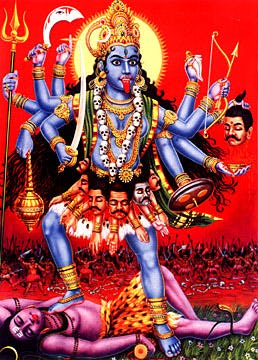
Step 4 KaaliKali is the Goddess of time and change representing both the creative and destructive aspects of Nature. She helps those who strive for knowledge of self.
Naalam Thruppadiye Sharanam Ayyappa
Step 5 Krishna KaaliKrishna Kali is one such deity with whom devotees have a very loving and intimate bond, in spite of her fearful appearance. She is known for destroying ignorance.
Ancham Thruppadiye Sharanam Ayyappa
Step 6 Shakti BairaviShakti Bhairavi is the ugra swaroopini of Shakti and she is known more to the devotees as the famous Yakshi – who is seated in the court of Lord Sastha
Aaraam Thruppadiye Sharanam Ayyappa
Step 7 KaarthaveeryarjunaKaartha Veeryaarjuna is an Amsha of Sudharshana Chakra. He got Satha Upasana from his Guru Datta and obtained many great powers and rose to a level of God
Ezhaam Thruppadiye Sharanam Ayyappa
Step 8 Krishnaabhan
Krishnabhan is more popularly known as Karuppan. He is the cheif of all the Bhootaganas of Sastha’s Bhootha sena. He is seen in almost every Sastha temple in Tamilnadu and few age old temples of Kerala.
Ettam Thruppadiye Sharanam Ayyappa
Krishnabhan is more popularly known as Karuppan. He is the cheif of all the Bhootaganas of Sastha’s Bhootha sena. He is seen in almost every Sastha temple in Tamilnadu and few age old temples of Kerala.
Ettam Thruppadiye Sharanam Ayyappa
Step 9 HidimbaHidimba is one of the chief warrior but also the preceptor born in the clan of Asuras. He is seated as the guardian deity of the ninth step.
Onpadham Thruppadiye Sharanam Ayyappa
Step 10 VethalaVethala is considered to be the head of Ghost and Goblins and in an amsha of Bhairava. Sastha is Bhoothanatha who controls these Ghosts and hence Vethala is one among his parivara.
Pathaam Thruppadiye Sharanam Ayyappa
Step 11 NaagarajaNagaraja is the king of the Serpants. In general Anantha is considered to be the King of the Naga Kingdom and he is stationed at the eleventh step here to destroy the Sarpa doshas of the devotees
Pathinonnam Thruppadiye Sharanam Ayyappa
Step 12 RenukaRenuka is the Mother of Parasurama who was killed and later resurrected by Parasurama. After the death of Jamadagni, Revana Siddha gave her Sasthru Deeksha at Padavedu and she is stationed here.
Pantrendam Thruppadiye Sharanam Ayyappa
Step 13 Swapna Varahi
Swapna Varahi is a form of Vartali who gets pleased with the devotees and comes and guides the devotees through dreams.
Pathimoonam Thruppadiye Sharanam Ayyappa
Swapna Varahi is a form of Vartali who gets pleased with the devotees and comes and guides the devotees through dreams.
Pathimoonam Thruppadiye Sharanam Ayyappa
Step 14 PratyangiraPratyangira is Ugra Swaroopini who is very much forceful in action and her primary duty is to protect the upasakas of Para Devata
Pathinalam Thruppadiye Sharanam Ayyappa
Step 15 Bhooma DeviBhoomadevi is the consort of the Varaha Moorthi. She is Dharma Swaroopini and represents Kshama- forgiveness. Holding a paddy sheaf in her hand, She also indicates prosperity
Pathinancham Thruppadiye Sharanam Ayyappa
Step 16 AghoraThe following there are Astra Devatas. Ever ready for prayoga against the evil. Agora is one of the Astra of Shiva which he created to destroy the Tripurasuras. It can grants worldly good and salvation to the soul.
Pathinaram Thruppadiye Sharanam Ayyappa
Step 17 PashupathaPashupata is Shiva’s personal asta and a most forceful one. It can even be discharged by eyes, words or mind. Its capable of destroying anything and can even stop creation.
Pathinezham Thruppadiye Sharanam Ayyappa
Step 18 MrutyunjayaMrutyunjaya is yet another Astra which gives eternal state to the aspirant. This is not just to live a healthy life and get rid of ailments. This conquers mrutyu – the permanent state of existence; Thats knowing the self; being self; Thats Thathwamasi.
Pathinettam Thruppadiye Sharanam Ayyappa
Thursday, 22 November 2018
Sacred Irumudi - THE HEAD BAG
Om Swamiye Saranam Ayyappa
lrumudi is the only travelling kit which a pilgrim carries on his head during the pilgrimage. Only those who observe fasting for 41 days are allowed to carry it. Without the Irumudi one is not allowed to step onto the holy 18 steps at the Sannidhanam.
This bag is in two compartments - the Munmudi (the front part) and the Pinmudi (the back part) & the opening at centre. The front portion is reserved for keeping all the puja articles and offerings to the deity. The rear part is meant to hold the pilgrims' personal requirements for the journey. |
Front portion contains Mudra bags, consisting of 2 - 3 in numbers - one for the GheeCoconut and the other two for the remaining offerings(Vazhipadu) at the Sannidhanam are as under:
Coconut filled with ghee for Abhishekam (bathing the idol of the Lord)+
Coconut (vidalai thengai) 2 to 4 nos.*
Beetel leaves, Beetel Nut, coins for offering
Jaggery (achuvellam), Cashew, Raisins, Dry ginger, Poha (thin & thick variety), Cardamoms, Dates, Honey, Avil(beaten rice), Kadhi Chakkar
Dried turmeric tubers, Turmeric powder, Blouse piece, Kumkum, Vibhooti, Sandal paste, Sambarani, Camphor, Agarbathi (Incense stick), Rosewater, Lemon, Rice and Dal for offering.
Coconut for ghee Abhishekam: Well before the Kettunira time, select a medium size coconut. Clean and polish the outer shell using a polishing paper. With a pointed instrument, open one eye of the coconut and empty the coconut water. Close it with a cork of correct size. The coconut is now ready for the Kettunira.
Coconut (Vidalai Thengai) one each to be broken at Erumeli, Sharam Kutti and two for Padinettampadi (the sacred 18 steps - once while climbing up for Shasta Darshan with the Irumudi and 2nd while returning after the worship
Part of the jaggery, cashew, raisin, cardamom, honey and dates can be used to make Panchamrutam for the Neivedya; part of the jaggery, dry ginger and cardamom can be used for preparing 'Panagam' as Neivedya
Back Portion contains
Items for use of the pilgrim from the day of commencement of the journey after Kettunira till his return and is kept in the back compartment(Pin Mudi), which are as under : Some snacks which one may require now and then during the trip and other raw materials for food items to be prepared during the journey. And pulses and rice needed for cooking can be included in Pinmudi.
Coconut filled with ghee for Abhishekam (bathing the idol of the Lord)+
Coconut (vidalai thengai) 2 to 4 nos.*
Beetel leaves, Beetel Nut, coins for offering
Jaggery (achuvellam), Cashew, Raisins, Dry ginger, Poha (thin & thick variety), Cardamoms, Dates, Honey, Avil(beaten rice), Kadhi Chakkar
Dried turmeric tubers, Turmeric powder, Blouse piece, Kumkum, Vibhooti, Sandal paste, Sambarani, Camphor, Agarbathi (Incense stick), Rosewater, Lemon, Rice and Dal for offering.
Coconut for ghee Abhishekam: Well before the Kettunira time, select a medium size coconut. Clean and polish the outer shell using a polishing paper. With a pointed instrument, open one eye of the coconut and empty the coconut water. Close it with a cork of correct size. The coconut is now ready for the Kettunira.
Coconut (Vidalai Thengai) one each to be broken at Erumeli, Sharam Kutti and two for Padinettampadi (the sacred 18 steps - once while climbing up for Shasta Darshan with the Irumudi and 2nd while returning after the worship
Part of the jaggery, cashew, raisin, cardamom, honey and dates can be used to make Panchamrutam for the Neivedya; part of the jaggery, dry ginger and cardamom can be used for preparing 'Panagam' as Neivedya
Back Portion contains
Items for use of the pilgrim from the day of commencement of the journey after Kettunira till his return and is kept in the back compartment(Pin Mudi), which are as under : Some snacks which one may require now and then during the trip and other raw materials for food items to be prepared during the journey. And pulses and rice needed for cooking can be included in Pinmudi.
Tuesday, 13 November 2018
MALAI ANNIVIPU VAIBAVAM
SWAMIYE SARANAM AYYAPPA
MALAI ANNIVIPU VAIBAVAM
KINDLY BE INFORMED THAT, THIS YEAR KARTHIGAI 1ST i.e MALAI ANNIVIPU VIZHA FOR LORD
AYYAPPASWAMY DEVOTEES AT OUR TEMPLE ARULMIGU SHIVA SHANKARA JAYA KAILASA MUNEESWARAR THIRUKOVIL, LOT 54988, JALAN SIAKAP, BATU 4 CHERAS KUALA LUMPUR WILL BE HELD ON THE 17th NOVEMBER 2018 (SATURDAY) @ 6.30PM ONWARDS.
17.11.18 (SATURDAY ) @ 6.30PM - MALAI
ANIVIPPU VAIBAVAM
17.11.18(SATURDAY ) @ 7.30PM - PADI POOJA, BHAJANS, THEEBARATHANAI FOLLOWED BY ANNATHANAM.
Things (Seer Thathu) devotees shall bring when they come to temple on Karthigai 1st:-
17.11.18(SATURDAY ) @ 7.30PM - PADI POOJA, BHAJANS, THEEBARATHANAI FOLLOWED BY ANNATHANAM.
Things (Seer Thathu) devotees shall bring when they come to temple on Karthigai 1st:-
- 2 sets of
Thulasi Mala with Ayyappa Locket
- Garland for Lord Ayyappaswamy,
- Fruits (Banana, orange, apple… etc.)
- Coconut
- Pooja item’s such as Sudam, Sambrani, Patti, Vibuthi,
Sandhanam, Kum-kum, Pannir, samy pattu & etc…
- Guru Thatchanai, minimum of RM1.25
- Garland for Lord Ayyappaswamy,
- Fruits (Banana, orange, apple… etc.)
- Coconut
- Pooja item’s such as Sudam, Sambrani, Patti, Vibuthi,
Sandhanam, Kum-kum, Pannir, samy pattu & etc…
- Guru Thatchanai, minimum of RM1.25
For more
enquires about the Viratham or any other information on temple Pooja’s, Ubayam
or Sabari Mala Yatra devotees are welcome to contact our temple management or
Guruswamy’s and Swamy’s at:-
THIRU MAHENDRAN GURUSAMY - 010 867 9075
THIRU GUNASEELA GURUSAMY – 012 288 4447
THIRU PREM SWAMY - 012 683 3235
THIRU LOGI SWAMY – 014 630 8160
THIRU GUNASEELA GURUSAMY – 012 288 4447
THIRU PREM SWAMY - 012 683 3235
THIRU LOGI SWAMY – 014 630 8160
SWAMIYE SARANAM AYYAPPA
NOTE ***
Swamy’s who intend to wear Ayyappa Malai are requested to come with proper HAIR
CUT.
The 18 Holy Steps - Patinettampadi
Om Swamiye Saranam Ayyappa
At first it was granite stone of 5 to 6 feet wide. Now it is covered by Panchloha in the year 1985. The vertical steps are so significant and blessed no one can scale them without fasting for 41 days and carrying the holy irrumudi bag on head.
There are many mythology connected with the holy Patinettampadi. Some believe the eighteen steps denotes the 18 puranas. Some say that 18 weapons with which Lord Ayyappa destroyed the evil denotes the 18 steps. Others are of the belief that the first five steps denotes the indriyas (eyes, ears, nose, tongue and skin). The next eight steps signifies the ragas (tatwa, kama, krodha, moha, lobha, madha, matsraya, and ahamkara. The next three steps signifies the gunas (satwa, rajas and thamas). The seventeenth and the eighteenth denotes vidhya and ignorance.
The Patinettampadi can be used only twice - once for climbing the temple and once for downward below leaving the hill. Before climbing or downward the steps, pilgrims break coconut as an offering to the steps. One needs to have the sacre Irumudi bag on head while going up or down the 18 steps. While downward the steps the devotees climb down backwards facing the sanctum sanctorum.
At first it was granite stone of 5 to 6 feet wide. Now it is covered by Panchloha in the year 1985. The vertical steps are so significant and blessed no one can scale them without fasting for 41 days and carrying the holy irrumudi bag on head.
There are many mythology connected with the holy Patinettampadi. Some believe the eighteen steps denotes the 18 puranas. Some say that 18 weapons with which Lord Ayyappa destroyed the evil denotes the 18 steps. Others are of the belief that the first five steps denotes the indriyas (eyes, ears, nose, tongue and skin). The next eight steps signifies the ragas (tatwa, kama, krodha, moha, lobha, madha, matsraya, and ahamkara. The next three steps signifies the gunas (satwa, rajas and thamas). The seventeenth and the eighteenth denotes vidhya and ignorance.
The Patinettampadi can be used only twice - once for climbing the temple and once for downward below leaving the hill. Before climbing or downward the steps, pilgrims break coconut as an offering to the steps. One needs to have the sacre Irumudi bag on head while going up or down the 18 steps. While downward the steps the devotees climb down backwards facing the sanctum sanctorum.
Friday, 3 August 2018
Lakshmi Mantra for Wealth
Venerated as Mahalakshmi, Lakshmi Devi is the consort of Lord Vishnu. While Lord Vishnu is the protector of the universe, Devi Mahalakshmi nurtures all the worlds with all the wealth. There are eight divine manifestations of Lakshmi including Adi Lakshmi, Gaja Lakshmi, Dhairya Lakshmi, Santana Lakshmi, Dhana Lakshmi, Dhanya Lakshmi, Vidya Lakshmi, and Vijaya Lakshmi. The import of all these manifestations is that Lakshmi is the giver of all forms of wealth needed for humans to live on this earth.
Being the goddess of wealth, Lakshmi is a very famous form worshipped by Hindus. She is very easily pleased and is so generous in showering her bounteous grace on her devotees. It is believed that Lakshmi resides in the door entrance of every house and therefore, it is a customary practice in orthodox Hindu homes to keep the doorstep clean and decorated to present a welcoming and auspicious look. Especially this has to be done while chanting the Lakshmi mantra for wealth.
Lakshmi Mantra for wealth is a simple one that people can chant regularly to please the merciful goddess.his mantra can be chanted anytime even while travelling or carrying on the daily work whether at home or office. However, for an involved sadhana, it is advised that the chanters take a holy bath, sit in front of the image or picture of goddess Lakshmi, light ghee lamp and incense sticks, offer vermilion and Kumkum, decorate the picture or idol with flowers, and offer betel leaves and nuts along with some Prasad. Once the setup is ready, Lakshmi mantra can be chanted for 1008 times if possible or 108 times regularly during the course of the sadhana.
Lakshmi Mantra for wealth:
Padma Priya Padmini Padma Haste Padmalaye Padma DalayadakshiViswa Priya Vishnu Manonukule Tvatpada Padmam Mayi SannidastvaSarasija Nilaye Saroja Haste Davala Damamshuka Gandha Malya ShobeBhagavati Hari Vallabh Mangone Tribhuvana Bhutikari Praseeda Mahyam
Lakshmi Mantra for wealth:
Padma Priya Padmini Padma Haste Padmalaye Padma DalayadakshiViswa Priya Vishnu Manonukule Tvatpada Padmam Mayi SannidastvaSarasija Nilaye Saroja Haste Davala Damamshuka Gandha Malya ShobeBhagavati Hari Vallabh Mangone Tribhuvana Bhutikari Praseeda Mahyam
Ganesha Pancharatnam Stotram Lyrics - Ganesha Pancha Rathnam Mantra
Aum Gam Ganathipataya Namaha
Ganesha Pancharatnam Stotram Lyrics - Ganesha Pancha Rathnam Mantra
Mudakaraatha Modakam Sada Vimukti Saadhakam
Kalaadharaavatamsakam Vilasiloka Rakshakam
Anaaya Kaika Naayakam Vinasitebha Daityakam
Nataasubhasu Naashakam Namaami Tham Vinaayakam.
I salute that remover of obstacles,
Who has modakas in his hand
Who always bestows salvation
Who wears a part of the moon on his head
Who protects this world which is varied,
Who is the leader of those who cannot be lead,
Who is the cause of the destruction of asuras,
And who destroys all the things which are not good.
Natetaraati Bheekaram Navoditaarka Bhaasvaram
Namat Suraari Nirjanam Nataadhi Kaapa Duddharam
Suresvaram Nidheesvaram Gajesvaram Ganeshvaram
Mahesvaram Samaasraye Paraatparam Nirantaram.
I bow before that great Lord permanently,
Who creates fear in the enemies of his devotees,
Who sparkles like the just risen Sun,
Who is saluted by Gods and Asuras
Who destroys the obstacles of his devotees,
Who is the God of all devas,
Who is the God of all wealth,
Who is the God of all elephants,
And who is the leader of the army of Lord Shiva
Samasta Loka Samkaram Nirasta Daitya Kunjaram
Daredarodaram Varam Vare Bhavaktra Maksharam
Krupaakaram Kshamaakaram Mudaakaram Yasaskaram
Manaskaram Namaskrutaam Namaskaromi Bhaasvaram.
I bow to that Ganapati who shines like the Sun,
Who bestows peace to all the worlds,
Who removed the Gajamukhasura from this world,
Who has a very big paunch,
Who has an elephant-face which blesses,
And who is the one who shows kindness
Who is tolerant
Who is full of blessing,
And who showers great fame,
To those who salute Him.
Akimchanaarti Marjanam Chirantanokti Bhaajanam
Puraari Poorva Nandanam Suraari Garva Charvanam
Prapancha Naasha Bheeshanam Dhananjayaadi Bhushanam
Kapola Daana Vaaranam Bhajaey Puraana Vaaranam.
I salute the very ancient elephant-god
Who destroys the wants of the have-nots,
Who has been worshipped since ancient times,
Who is the eldest son of the Lord who destroyed cities,
Who eats away the pride of the enemies of the gods,
Who is awesome at the time of final deluge,
Who wears serpents like Dananjaya as ornaments,
And who is fierce like the elephant in rut.
Nitaantikaanta Dantakaanti Mantakaanta Kaatmajam
Achintya Rupa Mantaheena Mantaraaya Krintanam
Hrudantarey Nirantaram Vasantameva
Yoginam Tameka Danta Meva Tam Vichintayaami Santatam.
I always meditate only on that God with a single tusk,,
Who is ever lustrous tusk is very pretty,
Who is the son of Lord who killed the god of death,
Who has a form beyond ones imagination,
Who is endless,
Who tears asunder all obstacles,
And who dwells forever in the heart of Yogis ,
Like the season of spring.
Phalasruthi
Maha Ganesa Pancha Rathna Maadharena Yo Anvaham,
Prajalpathi Prabhathake Hrudhi Smaran Ganeswaram,
Arogadhamadhosadham Susahitheem Suputhratham,
Samahithayurshta Bhoothi Mapyupaithi Sochiraath.
The resultant benefit of Chanting Ganesha Pancharatnam
These five gems of the great Lord Ganapati,
And who meditates in his heart the leader of Ganas,
Will soon be blessed with a healthy life,
Free of all problems, endowed with great peace
Great sons, longevity and spiritual and physical wealth.
Ganesha Pancharatnam Stotram Lyrics - Ganesha Pancha Rathnam Mantra
Mudakaraatha Modakam Sada Vimukti Saadhakam
Kalaadharaavatamsakam Vilasiloka Rakshakam
Anaaya Kaika Naayakam Vinasitebha Daityakam
Nataasubhasu Naashakam Namaami Tham Vinaayakam.
I salute that remover of obstacles,
Who has modakas in his hand
Who always bestows salvation
Who wears a part of the moon on his head
Who protects this world which is varied,
Who is the leader of those who cannot be lead,
Who is the cause of the destruction of asuras,
And who destroys all the things which are not good.
Natetaraati Bheekaram Navoditaarka Bhaasvaram
Namat Suraari Nirjanam Nataadhi Kaapa Duddharam
Suresvaram Nidheesvaram Gajesvaram Ganeshvaram
Mahesvaram Samaasraye Paraatparam Nirantaram.
I bow before that great Lord permanently,
Who creates fear in the enemies of his devotees,
Who sparkles like the just risen Sun,
Who is saluted by Gods and Asuras
Who destroys the obstacles of his devotees,
Who is the God of all devas,
Who is the God of all wealth,
Who is the God of all elephants,
And who is the leader of the army of Lord Shiva
Samasta Loka Samkaram Nirasta Daitya Kunjaram
Daredarodaram Varam Vare Bhavaktra Maksharam
Krupaakaram Kshamaakaram Mudaakaram Yasaskaram
Manaskaram Namaskrutaam Namaskaromi Bhaasvaram.
I bow to that Ganapati who shines like the Sun,
Who bestows peace to all the worlds,
Who removed the Gajamukhasura from this world,
Who has a very big paunch,
Who has an elephant-face which blesses,
And who is the one who shows kindness
Who is tolerant
Who is full of blessing,
And who showers great fame,
To those who salute Him.
Akimchanaarti Marjanam Chirantanokti Bhaajanam
Puraari Poorva Nandanam Suraari Garva Charvanam
Prapancha Naasha Bheeshanam Dhananjayaadi Bhushanam
Kapola Daana Vaaranam Bhajaey Puraana Vaaranam.
I salute the very ancient elephant-god
Who destroys the wants of the have-nots,
Who has been worshipped since ancient times,
Who is the eldest son of the Lord who destroyed cities,
Who eats away the pride of the enemies of the gods,
Who is awesome at the time of final deluge,
Who wears serpents like Dananjaya as ornaments,
And who is fierce like the elephant in rut.
Nitaantikaanta Dantakaanti Mantakaanta Kaatmajam
Achintya Rupa Mantaheena Mantaraaya Krintanam
Hrudantarey Nirantaram Vasantameva
Yoginam Tameka Danta Meva Tam Vichintayaami Santatam.
I always meditate only on that God with a single tusk,,
Who is ever lustrous tusk is very pretty,
Who is the son of Lord who killed the god of death,
Who has a form beyond ones imagination,
Who is endless,
Who tears asunder all obstacles,
And who dwells forever in the heart of Yogis ,
Like the season of spring.
Phalasruthi
Maha Ganesa Pancha Rathna Maadharena Yo Anvaham,
Prajalpathi Prabhathake Hrudhi Smaran Ganeswaram,
Arogadhamadhosadham Susahitheem Suputhratham,
Samahithayurshta Bhoothi Mapyupaithi Sochiraath.
The resultant benefit of Chanting Ganesha Pancharatnam
These five gems of the great Lord Ganapati,
And who meditates in his heart the leader of Ganas,
Will soon be blessed with a healthy life,
Free of all problems, endowed with great peace
Great sons, longevity and spiritual and physical wealth.
Sunday, 1 January 2017
Sunday, 9 October 2016
Saturday, 8 October 2016
What Can One Do If They Are Unable To Fast For All Nine Days Of Navaratri ?
Jai Ma......
The 10th day of Navaratri which falls on the Dasami thithi day is called Dussehra (also known as Vijaya Dasami). On the 10th day, Goddess Durga slayed the demon Mahishasura and therefore, she is known as Mahishasura Mardini. Therefore during Navaratri, you are also advised to chant the Mahishasura Mardini Gayatri Mantra and Mashishasura Mardini Stotra apart from the mantras dedicated to each Goddesses of a particular day.
What Can One Do If They Are Unable To Fast For All Nine Days Of Navaratri ?
If you are unable to fast for all nine days, then fasting on Sapthami (7th day), Ashthami (8th day), and Navami (9th day) are advised. If you are unable to do that, then you should try to fast at least on Ashthami (8th day) alone and offer your prayers to Goddess Durga to get her blessings. The 8th Day is called Durga Ashtami and this is a very special day among the nine days. According to puranas, on this day, Goddess Durga destroyed Thatcha’s yaaga and appeared with millions of Yogini Devis. That is why Ashthami day is a very special day during this festival.
Pregnant and lactating ladies as well as those undergoing their menstruation are not advised to fast. The same applies to the elderly and those with medical conditions as well as those under medications. Don’t fast if you can’t. Mother Goddess will not punish her “children” for not fasting.
Also, according to Pavisya Purana, one can just offer flowers and water during the prayers if you are unable to prepare in a grand manner. The most important thing is that you must do the Navaratri pooja with a pure heart and Mother Goddess will accept it happily.
To all those whom are unable or do not wish to observer fasting during this period, you are advised to observe vegetarianism and avoid alcohol during these 9 days.
9 Days Of Navaratri
The 9 days of Navaratri are dedicated to the 9 forms of Mother Goddess. The first day is dedicated to Goddess Shailaputri. The second day is dedicated to Goddess Brahmacharini. The third days is dedicated to Goddess Chandragantha. The fourth day is dedicated to Goddess Kushmanda, the fifth day is dedicated to Goddess Skanda Mata, Goddess Katyayani is prayed on the sixth day, Goddess Kaalratri on the seventh day, Goddess Maha Gauri on the 8th day, and Goddess Siddhidatri on the ninth day of Navaratri.
At times, the 9 days of Navaratri are also celebrated as a festival to beget the blessings of Goddess Parvathi, Goddess Lakshmi, and Goddess Saraswathi. The first 3 days are dedicated to Goddess Parvathi, the second 3 days are dedicated to Goddess Lakshmi, and the last 3 days are dedicated to Goddess Saraswathi.
Day Of FestivalTithi Goddesses Pooja For The Day
First Day Pratipada / Prathama Shailaputri Shailaputri Pooja
Second Day Dwithiya Brahmacharini Brahmacharini Pooja
Third Day Thrithiya Chandragantha Chandragantha Pooja
Fourth Day Chaturthi Kushmanda Bhouma Chaturthi
Fifth Day Panchami Skanda Mata Lalita Vrata & Skanda Mata Pooja
Sixth Day Shashthi Katyayani Saraswathi Avahana & Katyayani Pooja
Seventh Day Sapthami Kaalratri Saraswathi Pooja, Kaalratri Pooja, & Utsava
Eight Day Ashtami Maha Gauri Saraswathi Pooja, Durga Ashtami, Maha Gauri Pooja, & Chandi Pooja
Ninth Day Navami Siddhidatri Ayudha Pooja & Kanya Pooja
Tenth Day Dasami Durga Durga Pooja
Coun't..............
Thursday, 6 October 2016
HOW TO WORSHIP KALI MA
Jai Ma......
Many people, including spiritual leaders in shakti worship, tend to unintentionally complicate simple things such as daily prayer. Because of this, those who are new to the belief system, find themselves lacking confidence and feeling discouraged from praying in fear that “they’re doing it wrong”.
I’m here to give you the secret to praying to Kali Ma and also a practical daily prayer ritual for those who find comfort in routine.
How to worship Kali Ma, Kateri Ma and any deity
THE SECRET TO WORSHIPPING KALI MA IS THIS:
Love her. Every word you utter to her, every offering you give her, do it from love and with love. If you’re very new to Shakti worship it will be difficult to love her. I understand that. How do you love that which you do not know?
Do children know to love their mothers the moment they are born? I do not believe so. But as a mother myself, I can tell you I loved my children the moment I knew of their existence, as the Mother Kali does with all of her children. So do not be afraid to approach her. Feel confident in the fact that she already loves you.
Take the time to get to know her. Learn about her. The way newborns learn to love their mothers. There is no rush. It will happen in a blink of an eye.
If you’re feeling rushed to worship her because of dire circumstances, then you must already have some faith in her existence and respect for her power. You must have some knowledge of who she is and how she helps her children. If this is why you’re looking to learn to worship her, it’s understandable and absolutely acceptable. Feel confident in the fact that she already loves you.
So how do you pray to her when you do not know her well enough to love her?
If you’re feeling rushed to worship her because of dire circumstances, then you must already have some faith in her existence and respect for her power. You must have some knowledge of who she is and how she helps her children. If this is why you’re looking to learn to worship her, it’s understandable and absolutely acceptable. Feel confident in the fact that she already loves you.
So how do you pray to her when you do not know her well enough to love her?
You start with respect and faith and honesty. Do not just read these words and nod your head. Before you take your next step in worshipping any deity, it is important to be honest with yourself about why you’re doing so. Contemplate what it is about that deity that you know and believe in.
When my friend Eddie first started worshipping the Mother Kali, he admitted to knowing nothing of her but what he grew up hearing, which was to fear her because she was mega powerful. Eddie knew of people in his village in Guyana who went to Kali Temple every weekend and had yearly pujas for this Mother where they offered her a goat.
Every photo he saw of Mother Kali, she was half naked, with skulls around the neck, blood dripping from her mouth, a head in one hand, a machete in the other… all while she trampled her husband, Lord Shiva, with one powerful foot. Of course he was scared! Eddie said he was a teen believing that worshipping this Mother was some form of voodoo.
But then his life went to crap. A wise person spoke to him about Mother Kali. Told Eddie stories about Mother Kali from the Shri Devi Bhagvatam and the Shiv Purana. Shared personal stories about his 20 years of experience in service to the Mother Kali. This wise man then gave Eddie a photo of her so he could focus on her while praying. Eddie was told to light her a tea candle, offer her a cup of water and pray to her. He was to then close his prayer by chanting her mantra – Om Klim Kalika-Yei Namaha – 108 times. After doing this for 3 days, she began to dream him (he did not dream of her, but instead she gave him dreams). She advised him. Within weeks Eddie’s life changed. Eddie said to me that he felt nothing but love and compassion from her. It’s been 7 years, he is still her devotee, he refers to himself as her son and has a happy life.
The Pujarie in my temple always says, when you pray to Mother Kali, it’s like a child crying out to a mother. And Mother Kali always responds as a mother who hears her child cry. Think about that. What does a mother do the moment she hears her child crying?
PRACTICAL RITUAL FOR EVERYDAY/ANYDAY WORSHIP
For those who like to have a “praying routine” to perform service to this great Mother or any deity, please see below. Please note, you can omit anything you do not have in the list of supplies and there’s no specific order for giving offerings though you do always want to start with a light and water and end with bowing.
SUPPLIES
A photo of the Deity.
A “light”. This can be a dia with ghee and a wick, a tea candle or a devotional candle that you can out and relight when needed. Have a dia but no wick? Rip a strip of paper towel and twist it until it’s nice and tight.
A glass of water. The glass can be a new plastic/styrofoam cup, a lota, or a glass never used before. Size does not matter.
Incense.
Perfume.
A Flower or Fruit. These should be washed before beginning. Do not eat from the fruits until after.
Water in a cup or bowl with a spoon for sprinkling.
Rudraksha beads if you plan to chant a mantra 108 times. I suggest these as they are semi-smooth and won’t cause bruising: Rudraksha Beads.
An alter. This is anywhere clean (a table, shelf, a bookcase) in a room where you do not eat, drink alcohol, get naked or get intimate. This place should be your permanent place for prayer until which time you need to find another place to make permanent.
PRE PRAYER STEPS
Though you can pray any time during the day, the best time of day is the 2 hours before sunrise. This is a time when your home and neighborhood will mostly be quiet and you can focus and concentrate without distractions.
An alter of any type is a sacred place. When praying to any Vedic/Shakti/Tantric deity, it’s best take a shower first and not have any meat, eggs, alcohol or intimacy before approaching the alter. Usually I abstain from these indulgences starting from 12am so I can pray between 4am and 6am. I do check online for the sunrise time in hopes that I’ll get an extra 30 minutes of sleep.
😉
When following the below steps, you can say a mantra as you go. This helps you concentrate.
If you’re praying to Kali Ma, you can say: Aum Kring Kalakayei Namaha.
If you’re praying to Lord Shiva, you can say: Om Namah Shivaya
Lord Ganesh: Aum Gum Ganapatiyei Namaha.
Mother Durga: Aum Dum Durgayei Namaha.
Other deities you can say: Aum Namo Shri (Deity’s Name) Ai Yei Namaha.
Sit in a comfortable position. Keep your back straight. Drop your shoulders. Close your eyes and begin long, slow deep breathing. Disconnect yourself from concerns/problems/your to-do list.
Bring your hands together at the chest and open your prayer by chanting Aum with a full exhalation.
Say this a few times until you feel relaxed.
Open your eyes.
Place the cup of water in front of the deity.
Pick up the “light” with your right hand and circle the altar with it 3 times in a clockwise direction. (this is called offering arti)
Circle the deity with the incense in the same manner.
Circle the deity with perfume in the same manner while spraying.
With your right hand, sprinkle water in a clockwise direction to cool the atmosphere.
Offer fruit offerings to the deity using your right hand. You can feel free to arti the deity with the offering before putting it nicely down in front of them.
Offer flowers to the deity using your right hand. You can feel free to arti the deity with the offering before putting it nicely down in front of them.
Place your palms together again and pray to The Great Loving Mother (or the deity you have chosen). You may feel your mind go blank. You may get anxious worrying that you should be reciting a special prayer at this time. STOP. This is the time that you take to communicate with Mother Kali. Tell her what’s on your mind. What you’re struggling with. Unburden yourself. And then ask for assistance, her guidance and her blessings.
Pick up the “light” and arti the deity with it.
Touch your head to the ground before the deity saying Jai Kali Mata! (or Jai Deity Name!)
CHANTING
Chanting is a simple act of devotion based on the ancient practice of japa yoga. By saying it’s simple, I mean it’s easy to do. But the act itself is not simple when it comes to the changes it can bring about. The purpose of this and other rituals to the Divine Mother is to open yourself to her powers and to allow her to influence the flow of your life. You can expect changes in your mental state, the environment around you and the issues in your life. This is because when you allow yourself to connect with the Divine Mother in this way, you are tuning your consciousness to hers and by doing so you are changing your thought process to be more like hers. You will notice that you handle situations differently, react to people differently, have more sympathy, less stress and have more love for yourself and those around you.
So how do you chant? Chanting is the simple act of sitting in a comfortable position, eyes closed, repeating a mantra (any listed in the Pre Prayer section above is a good start) silently or aloud. The mind is focused on the mantra, the thoughts are let go of and the breath is slow and deep. When using beads you would start with one round, this means for every bead you will say the mantra once, that’s 108 times. As 108 becomes easy you would increase to two rounds of the beads and so on.
Hold your beads in your right hand, hanging the beads off your middle finger and use your thumb to count each mantra by touching the bead during the recitation and then lightly pulling the bead towards you on completion and moving to the next bead. The large meru bead should not be counted. It’s used as a starting and ending point of the recitation.
If you do not have the beads listed in the Supply list, you can set a timer for 10 minutes. When ten minutes becomes easy, set the timer for 15 minutes and increase as you go.
As you get into a routine a chanting, you may begin to feel a fine vibration. It’s a tingling feeling across the skin. Do not be afraid. This is the power of the Divine Mother that you’re feeling. Embrace it with joy.
MAHALAKSHMI ASHTAKAM
MAHALAKSHMI ASHTAKAM:
Mahalakshmi Astakam is the Hindu devotional stotra address to Goddess Lakshmi Devi, the divine consort of Lord Vishnu. It is said that chanting Mahalakshmi Ashtakam with great devotion elevates a person spiritually, financially and with blessings of Mahalakshmi.
Namosthesthu Maha Maye,
Sree Peede, Sura Poojithe,
Sanka, Chakra, Gadha Hasthe,
Maha Lakshmi Namosthuthe 1
Salutations and salutations to Goddess Mahalakshmi,
Who is the great enchantress,
Who lives in riches,
Who is worshipped by Gods,
And who has conch, wheel and mace in her hands.
Namasthe Garudarude,
Kolasura Bhayam Kari,
Sarva Papa Hare Devi,
Maha Lakshmi Namosthuthe 2
Salutations and salutations to Goddess Mahalakshmi.
Who rides on an Eagle,
Who created fear to Kolasura,
And is the goddess who can destroy all sins
Sarvagne Sarva Varadhe,
Sarva Dushta Bhayam Karee,
Sarva Dukha Hare Devi,
Maha Lakshmi Namosthuthe 3
Salutations and salutations to Goddess Mahalakshmi
Who knows everything,
Who can grant anything,
Who appears fearsome to bad people,
And is the goddess who can destroy all sorrows.
Sidhi Budhi Pradhe Devi,
Bhakthi Mukthi Pradayinee,
Manthra Moorthe Sada Devi,
Maha Lakshmi Namosthuthe 4
Salutations and salutations to Goddess Mahalakshmi,
Who grants intelligence and occult powers,
Who grants devotion to God and salvation,
Who can be personified by holy chants,
And who is Goddess for ever.
Adhyantha Rahithe Devi,
Adhi Shakthi Maheswari,
Yogaje Yoga Sambhoothe,
Maha Lakshmi Namosthuthe 5
Salutations and salutations to Goddess Mahalakshmi.
Who neither has an end nor beginning,
Who is the primeval power,
Who is the greatest Goddess,
Who is born out of hard penance,
And who can be personified by meditation.
Sthoola Sukshma Maha Roudhre,
Maha Shakthi Maho Dhare,
Maha Papa Hare Devi,
Maha Lakshmi Namosthuthe 6
Salutations and salutations to Goddess Maha Lakshmi,
Who is micro and also gross,
Who is most fearsome ,
Who is the greatest strength,
Who within her holds the worlds,
And is the Goddess who can destroy sins.
Padmasana Sthithe Devi,
Para Brahma Swaroopini,
Para Mesi, Jagan Matha,
Maha Lakshmi Namosthuthe 7
Salutations and salutations to Goddess Mahalakshmi,
Who is the goddess who has the seat of Lotus,
Who is the personification of the ultimate truth,
Who is Goddess of all,
And who is the mother of all the worlds.
Swethambara Dhare Devi,
Nanalankara Bhooshithe,
Jagat Sthithe, Jagan Matha,
Maha Lakshmi Namosthuthe 8
Salutations and salutations to Goddess Mahalakshmi,
Who wears white cloth,
Who wears variety of ornaments,
Who is everywhere in the world,
And who is the mother of all the worlds.
Phala Sruthi
Maha Lakmyashtakam Stotram,
Ya Padeth Bhakthiman Nara,
Sarva Sidhi Mavapnothi,
Rajyam Prapnothi Sarvadha.
Kumkum Pooja Purpose & Advantage:
Jai Ma.....
Observed for the well-being of the husband and a happy and prosperous married life.
To blesses with good health by getting rid of diseases.
To get deerga sowmangalyam & Vamsa vruddi.
To blessed with Happy married life.
To achieve the ultimate state or enlightenment.
What we do:
To blesses with good health by getting rid of diseases.
To get deerga sowmangalyam & Vamsa vruddi.
To blessed with Happy married life.
To achieve the ultimate state or enlightenment.
What we do:
Are you looking Pandit for Kumkuma Puja and Kumkuma Puja Samagri? We provide a facility of Book the Priest / Pandits to conduct the Kumkuma Puja at your Home at right time.
We will guide the rules of puja and make to complete your puja with full of shaucha(Full of purity and conscientiously)
Description:
Description:
We perform kumkuma puja for Durga Mata at your home with Sri Sukta samputita Vidhan. Puja will starts with Swansti mantra and Ganesh pooja. Then Mandapa aaradhana & Durga mata Sthapana will done. Then after Mata will decorated with ornaments and garlands. Shodasha Upachara puja and Archana will done along with 108 names of Lord Durga Mata with Kumkuma, flowers and etc., Then after Naivedya, Tamboola, Nirajan & mantra pushpam will give for Lord Durga Mata. Finallyt the panditji will give you the Prasadam of Lord Durga Mata
Sarva Manggala Maanggalye Shive Sarvaartha Saadhike!
Sharannye Tryambake Gowri Naaraayanni Namostu Te!!
10 Poojas That Make Your Wishes Come True
Aum Namah Shivaya.....
Laxmi poja
Shanidev Pooja
Parthiv Shivling Pooja
Kaalsarp Dosh Nivarana Pooja-001
Mangal Dosh Nivarana Pooja-001
Mahamrityunjay Mantra Jaap
Satyanarayan Katha and Havan
Hanuman Pooja
Katyayani Pooja
Poojas are important events in the lives of Hindu devotees. Even with our fast-paced lives and strict schedules, we try to make time to offer poojas in order to seek God’s blessings and ensure a prosperous life.
Ganesh poja
Lord Ganesh is one of the most important deities in Hinduism and no other pooja can be performed without worshipping him first. However, even an exclusive pooja of Lord Ganesh has many amazing benefits for a devotee’s life. Ganesh Pooja ushers in good health, wealth, prosperity and success.
Laxmi poja
Maa Lakshmi is one of the key forms of Shakti and is widely revered by her devotees. She is one of the Trimurti goddesses of Hinduism, along with Durga and Saraswati. No wonder, Lakshmi Pooja offers many key benefits for a person’s life.
Shanidev Pooja
The offering of oil to Swayambhu Shanidev at the holy shrine of Shingnapur is the most powerful remedy for Shani Dosh. Devotees from across the nation visit Shanidev’s temple at Shingnapur to perform tailabhishekam, which also gets rid of bad karmic influences, marital and personal problems, besides eliminating Shani Dosh completely.
Parthiv Shivling Pooja
Parthiv Shivling Pooja is a special pooja dedicated to Lord Shiva. The Parthiv Shivling is a shivling made of mud/sand. As many as 108 Parthi Shivlings are made on the banks of the holy Ganga river, with abhishek being performed on your behalf. This pooja can be done at the Omkareshwar and Kashi Jyoptirlinga temples and has several benefits. It is an effective cure for Grah Dosh, diseases, misfortune, accidents and reduces stress as well.
Kaalsarp Dosh Nivarana Pooja-001
Kaalsarp Yog exists when all seven planets (Sun, Moon, Mars, Venus, Jupiter, Saturn, and Mercury) are aligned between Rahu and Ketu. People born during this period are said to be suffering from misfortune and death-like painful experiences throughout their lives. The Kaalsarp Dosh Nivaran Pooja is quite effective in removing the negative effects of Kaalsarp Dosh, which immensely improves the lives of devotees.
Mangal Dosh Nivarana Pooja-001
Mars or Mangal is a fiery planet and one of the main Navagrahas that hugely influence life on earth. Mangal Dosh Nivarana Pooja removes obstacles in personal and professional life, gets rid of Manglik Dosh, and encourages positive thoughts and actions.
Mahamrityunjay Mantra Jaap
The Mahamrityunjaya Mantra is one of the most powerful Shiva mantras and is also extremely effective in seeking his blessings. It has the power to destroy all negative spiritual effects, creates a kavach of protection over one’s family and helps one become ambitious.
Satyanarayan Katha and Havan
Satyanarayan is one of the most famous forms of Lord Vishnu, who is widely revered by Hindus everywhere. This form of Lord Vishnu is considered as the embodiment of truth and is quite famous amongst Vishnu bhakts. Performing Satyanarayan Pooja during Purnima days is considered particularly auspicious. It helps one become successful in life and improves one’s body and mind.
Hanuman Pooja
Hanumanji is considered an incarnation of Lord Shiva. He is also regarded as an ardent devotee of Lord Rama. Hanuman Puja is done before sunrise with Hanuman Chalisa Jaap. Performing Hanumanji’s Pooja and aarti offers many benefits for you and your family. This pooja removes fear from the hearts of devotees and gives them courage to face all difficulties of life.
Katyayani Pooja
Maa Katyayani is a manifestation of Maa Shakti, who is one of the key deities of Hinduism. Each year, millions of devotees visit the various Shaktipeeth temples to offer Pooja to Maa Katyayani. It is one of the most important Devi Poojas and has tremendous benefits. Katyayani Pooja can eliminate Manglik Dosh, bring happiness to married life, and overall benefits to the quality of family life.
Subscribe to:
Posts (Atom)